Have Got &
Possessive ‘s
What have you got? – Possessions, belongings and ownership
Have Got & Possessive ‘s
A1 / A1+ – Possessions, Belongings and Ownership – What have you got?
1Vocabulary – My Belongings / Moje rzeczy

Zanim nauczymy sie budowac zdania, poznajmy przedmioty, ktore najczesciej posiadamy. / Before we build sentences, let’s learn the most common things we own.
| Object / Przedmiot | Polish / Po polsku | Example / Przyklad |
|---|---|---|
| Smartphone | smartfon | I’ve got a new smartphone. |
| Laptop / Tablet | laptop / tablet | She’s got a laptop for school. |
| Keys | klucze | Have you got the keys? |
| Wallet | portfel | He’s got a blue wallet. |
| Bicycle | rower | We’ve got two bicycles. |
| Pet (Dog / Cat) | zwierze (pies / kot) | She’s got a cat called Luna. |
| Camera | aparat fotograficzny | My dad’s got a big camera. |
| Skateboard | deskorolka | I haven’t got a skateboard. |
2Grammar – Have Got / Has Got
EN – Using “Have Got” (To possess)
In British English, we use have got to talk about things we own, family members, or physical appearance (like eye colour or height).
| Type | Subject | Form | Example |
|---|---|---|---|
| Affirmative | I / You / We / They | have got (‘ve got) | I’ve got a new laptop. |
| He / She / It | has got (‘s got) | He’s got a big dog. | |
| Negative | I / You / We / They | haven’t got | We haven’t got any milk. |
| He / She / It | hasn’t got | She hasn’t got a car. | |
| Question | Have/Has + Subject + got? | Have you got the keys? | |
Short answers use ONLY have or has — never “got”!
Contractions: I have got = I’ve got | She has got = She’s got
Co to jest “have got”?
HAVE GOT / HAS GOT to jedna z najwazniejszych konstrukcji na poziomie A1. Uzywamy jej, aby powiedziec, ze cos posiadamy, opisujemy czlonkow rodziny lub cechy wygladu.
Zdania twierdzace (Affirmative)
W trzeciej osobie liczby pojedynczej (he, she, it) forma zmienia sie na ‘has got’.
- I / You / We / They + have got (skrot: ‘ve got)
- He / She / It + has got (skrot: ‘s got)
I have got a big dog. = I‘ve got a big dog. (Mam duzego psa.)
She has got a new car. = She‘s got a new car. (Ona ma nowy samochod.)
Przeczenia i Pytania (Negative and Questions)
| Typ | Budowa | Przyklad |
|---|---|---|
| Negative | haven’t got / hasn’t got | I haven’t got a cat. |
| Question | Have/Has + podmiot + got? | Have you got a pen? |
Have you got a phone? — Yes, I have. / No, I haven’t.
3Grammar – Possessive ‘s (Saxon Genitive)
EN – The Possessive ‘s – Showing who owns something
This is the fastest way to show that something belongs to someone. Formula: Owner + ‘s + The Object
| Rule | Example | Polish |
|---|---|---|
| Singular: add ‘s | The cat‘s tail | Tom‘s car | Ogon kota | Samochod Toma |
| Regular plural (-s): add ‘ only | The teachers‘ room | My parents‘ house | Pokoj nauczycieli | Dom rodzicow |
| Irregular plural (no -s): add ‘s | The children‘s toys | Zabawki dzieci |
| Name ending in -s: add ‘s or ‘ | Lucas‘s / Lucas‘ phone | Telefon Lukasa |
The ‘s Challenge — Is it “is” or “possession”?
He‘s tall. — He is tall. (Description / Opis)
He‘s got a car. — He has got a car. (Possession / Posiadanie)
It‘s Ben‘s car. — It is Ben’s car. (Ownership / Wlasnosc)
Co to jest dopelniacz saksonski?
To bardzo krotki sposob, by powiedziec, ze cos nalezy do danej osoby. Zamiast mowic “the car of Tom”, powiemy “Tom’s car”.
Wazne przypadki specjalne
- Liczba mnoga zakonczona na -s: dodajemy tylko sam apostrof.
My parents‘ house — Dom moich rodzicow (nie: parents’s) - Imiona konczace sie na -s: mozemy dodac sam apostrof lub ‘s.
Lucas‘ phone LUB Lucas‘s phone - Nieregularna liczba mnoga: stosujemy normalnie ‘s.
Children‘s toys — Zabawki dzieci
Roznica miedzy ‘s (is/has got) a ‘s (posiadanie)
She‘s elegant. (She is — Ona jest elegancka.)
She‘s Emma‘s sister. (Emma‘s — Siostra Emmy.)
She‘s got a cat. (She has got — Ona ma kota.)
4Reading – The New Room
Przeczytaj krotki tekst i sprawdz, co posiada rodzenstwo. / Read the short text and check what the siblings have got.
Hi! My name is Tom. I have got a very cool bedroom. In my room, I’ve got a new laptop and a lot of books. I haven’t got a TV, but that’s okay.
My sister, Emma, has got a beautiful room too. She has got a big guitar and a very soft cat called Luna. We have both got bicycles, so we often go to the park together.
True or False? / Prawda czy falsz?
1. Tom has got a TV in his room.
2. Emma has got a guitar.
3. Tom and Emma have got bicycles.
4. The cat is Tom’s pet.
5Interactive Exercises
Exercise A – Choose have got or has got
Wybierz have got / has got / haven’t got / hasn’t got.
1. My father a blue wallet.
2. We a big garden.
3. You a very nice smartphone.
4. The cat beautiful green eyes.
5. I a skateboard, but I a bicycle.
Exercise B – Questions / Ulozy pytania
Put the words in order to make questions. / Ulozy slowa, zeby stworzyc pytania.
6Listening – What’s in Ben’s Bag?
Postuchaj nagrania i odpowiedz na pytania. / Listen and answer the questions about Ben.
Listening Questions / Pytania do nagrania
1. What has Ben got for lunch?
2. Where is his phone?
3. Who is the apple for?
7Task 1 – Have Got vs Has Got (MCQ)
Choose the correct form / Wybierz poprawna forme
1. My brother ___ a blue wallet.
2. I ___ a cat, but I have a dog.
3. ___ your parents got a new car?
4. The cat ___ beautiful green eyes.
5. We ___ a big garden in our house.
6. ___ she got a laptop for school?
7. They ___ two sisters and one brother.
8. My teacher ___ a red pen today.
8Task 2 – Possessive ‘s
Insert ‘s or s’ in the correct place / Wstaw apostrof
Write the correct possessive form (owner + ‘s or s’). / Napisz poprawna forme dopelniacza.
9Task 3 – Translate (have got + Possessive ‘s)
Przetlumacz na jezyk angielski / Translate to English
Use BOTH have got and possessive ‘s in each sentence. / Uzyj obu struktur — have got i dopelniacza saksonskiego.
10Writing Tasks
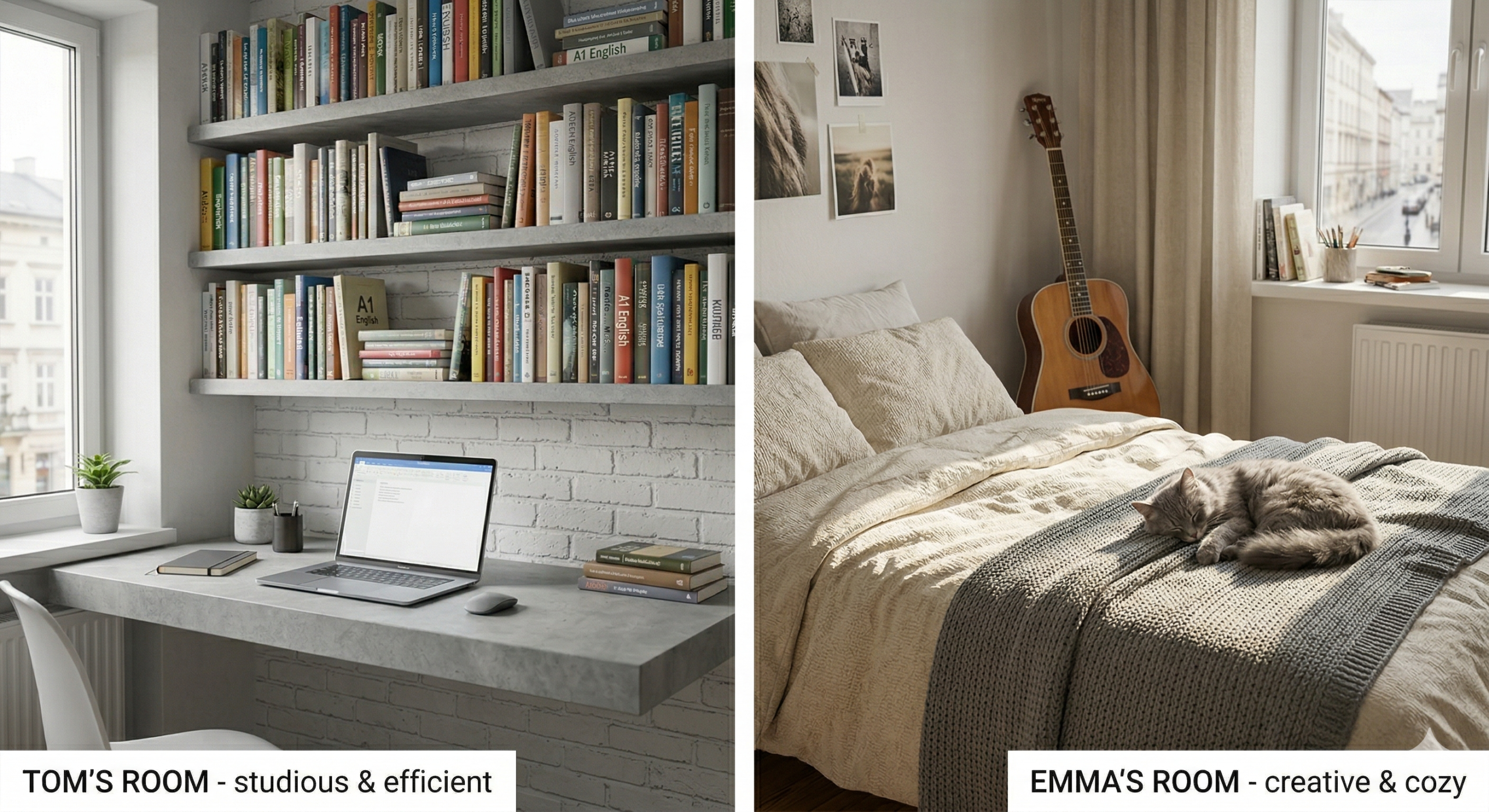
Writing A – Describe the room above
Write 4-6 sentences. Include / Napisz 4-6 zdan:
- What has the room got? / Co ma ten pokoj?
- What hasn’t it got? / Czego nie ma?
- Whose room is it? Use Possessive ‘s. / Czyj to pokoj? Uzyj dopelniacza saksonskiego.
Useful expressions / Przydatne wyrazenia:
Writing B – My Treasure Bag
Imagine you are going to a desert island. You can take only 5 things. Write about them! (4-6 sentences)
Wyobraz sobie, ze jedziesz na bezludna wyspe i mozesz zabrac tylko 5 rzeczy. Napisz o nich!
Use these phrases / Uzyj tych zwrotow:
11Speaking – Guess What I Have!
Lesson Complete!
Send your results to your teacher / Wyslij wyniki do nauczyciela